Once registered, you can create or join a group to take this assessment with your team and to compare your perception with those of your team members.
Your team's average score will only be meaningful after all team members have rated the team. Review your team scores only once all assessments have been made. Read our FAQ.
Team Collaboration AssessmentAssessing Team Health
Building Collaborative Capacity
How does this work?
This online high-performance team assessment allows you or your team to assess the collaborative capacity of your team culture. The tool specifically explores criteria that distinguish average-performing from high-performing teams. Read our FAQ.
You will not need to register to take the assessment. However, as a registered user you can:
Review and revise your past assessment
Invite team members to jointly assess your team and see your ratings compared to the average of your team members’ ratings
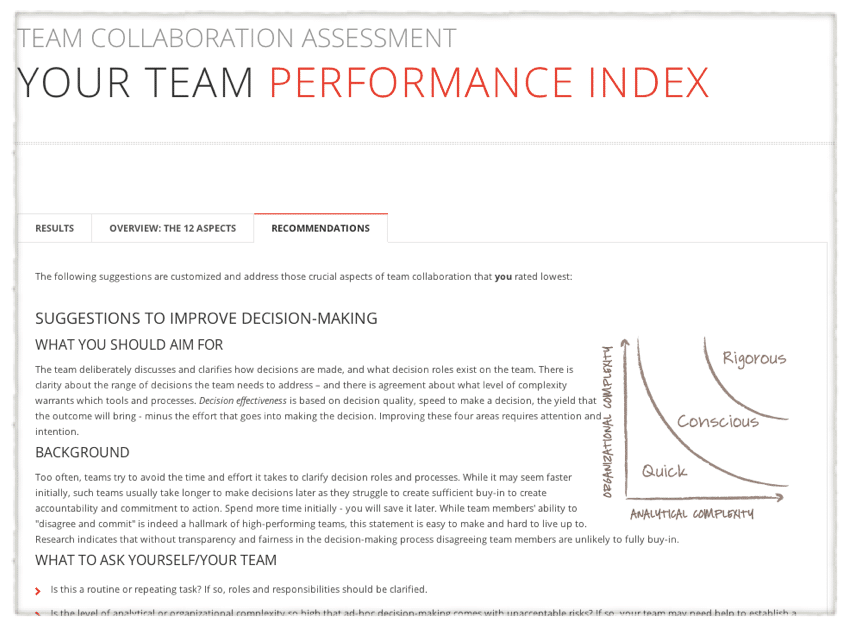
Read tips for improving lowest scored areas to build collaborative teams
Recall a specific team you wish to rate – the interactions, attitudes, behaviors that are at the core of this team’s culture. Click and drag slider or enter a percentage score in the text field for each critical success factor for team collaboration. (Hover over the question mark to learn more about this aspect.)
Answer each question on a 0%-100% scale:
100% – means your team consistently handles this aspect extremely well. Even if team members did a better job with this aspect, team performance wouldn’t increase. Few teams will have fully maximized a given aspect.
50% – means this aspect is neutral – there is “no pain – no gain”. While it doesn’t harm your team, your team doesn’t utilize the opportunity that comes from this aspect.
0 % – means the stark lack to exhibit this behavior/attitude creates dysfunctionality and significantly hinders/harms your team’s ability to perform. Few teams will perform so poorly.
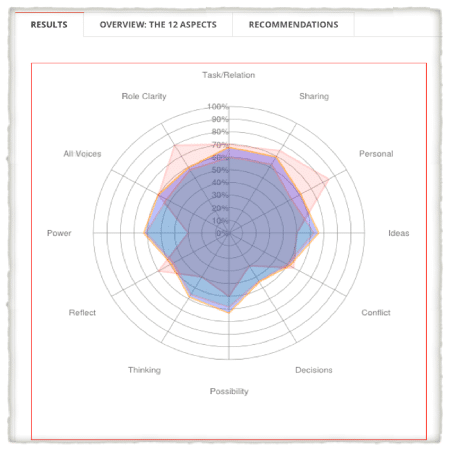
Think about your experience on a team and rate its performance on the 12 characteristics shown below.
Adjust the slider from 0% (left) to 100% (right) for each aspect.
The team focuses on both task and relationship
0
0
…team members show different approaches toward getting tasks accomplished – by either supporting task and role clarity or by strengthening relationships. Team leaders adjust their work style flexibly, and they also understand the different conditions that require either a task or relationship focus.
Team members openly share information
0
0
… team members are easily accessible to each other, generously provide contextual information, and openly share rationales for their decisions as much as difficulties and setbacks.
Team members provide personal information
0
0
…individuals provide meaningful personal information that fosters human connection. While team members don’t try to influence others through befriending them, they actively aim at strengthening their relationship basis to build trust and connections required for having difficult conversations.
Team members have a habit of building on each other’s ideas
0
0
…team members acknowledge and include ideas of others during brainstorming and problem-solving sessions. Team members actively look for connections among their respective ideas and take different ideas as stepping stone for their own contributions.
Team members address conflict timely
0
0
…conflict – interpersonal or intra-team – is addressed directly or soon after it emerges. Rather than using “undercover” forms of venting or influencing (such as triangulating, private coalitions), team members address their differing opinions or needs directly with each other and use conflict-resolving communication.
The team discusses norms for decision-making
0
0
…the team deliberately discusses and clarifies how decisions are made, and what decision roles exist on the team. There is clarity about the range of decisions the team needs to address - and consensus about which decisions are critical. There is agreement about what level of complexity warrants a more structured approach and respective tools and processes are in place.
Team members focus on possibility
0
0
…team members stay connected to the strategic goal and bigger picture during decision-making and execution. Rather than getting stuck on problems, team members keep an eye on the big picture and on the right and important aspects ready to unfold.
The team manages different ways to think
0
0
…team members can appropriately switch between fact finding, analysis, and problem solving, between idealism and pragmatism, and different members in the team assume different “thinking hats” at different times.
The team makes time to reflect how work gets done
0
0
…team members regularly talk about the helping and hindering factors to the team’s ability to collaborate effectively. Such conversations focus on communication, team dynamics, commitment, and accountability issues rather than timelines and deliverables.
On the team, the use of formal power is limited
0
0
…team leaders and team members avoid the use of power, rank, or status – but rather seek to influence each other by setting positive personal examples, building meaningful relationships, and by providing transparency about one’s own reasoning, values, and objectives. Broad consensus is sought - but the leader will make the final call if the team struggles to decide.
Team members ensure no one dominates the discussion
0
0
…team members understand that no one person or faction has "the answer". They actively seek to bring different perspectives to a given problem, invite voices they haven't heard from in a while, and make sure everybody talks in a reasonably equal measure.
Team members are clear about roles and responsibilities
0
0
…team members make time to set up, review, and revise their roles and responsibilities on the team. Interdependence of roles as a reality of teamwork is accepted and role-related conflict reduced whenever possible. Team members strive to meet mutual needs.
How would you describe the effectiveness of the team?